
Business Intelligence what is it?

Business Intelligence is the process of exposing the results of customer workflows in an easy to consume fashion for Business Analysts, Accountants and Executives. 

When your product is software that your customers’ use, it can be hard to know how customers are using it in the large. For BI you log whatever the customer did in a format that is easy to query via SQL. For purchasing flow you log.

{
    "customerId": "ABC",
    "itemId": 1234,
    "time": "12:34 AM",
    "price": "$13.87",
    ……
    "sessionId": 987
}

Then analysts can figure out usage patterns, discover and fix bad customer experiences and generally figure out what customers are doing. 

How is this different from normal logging? 

Programmers care about exceptions, lines of code and values of variables. The business cares where the customer was in the workflow, what did the customer click on, what happened after that. If there was a silent retry that the customer didn’t notice the business analysts don’t care. 

They care about what customers are doing and how the software responds more so than what the software is doing. 

BI logging is typically preserved durably over at least months and needs to adhere to a schema that makes aggregating data together easy later on. This can be achieved with normal structured logging or by adding a separate code flow just for ‘Business’ logs. 

If you like my writing, please buy my book on Amazon.
The Sledgeworx Guide to Getting into Software

Multiple promotions for solving the same problem

One failure mode I’ve seen in software organizations is multiple promotions for building the same solution to a problem. Suppose, in your software organization you have 10 teams working in a similar problem space. In one year you see two promotions for building an asset management pipeline. When I saw the second promotion announcement, I was thinking to myself “Wait, didn’t Tyler get promoted for building an asset management pipeline?”

Any Vice-President who’s organization has this issue should be thinking hard about where it went wrong. That engineering culture is completely broken and can only be fixed by rooting out the leadership and then replacing senior engineers. 

Why is this such a big deal? Because its a symptom of several serious problems in your organization.

No information sharing between teams

One team built a solution to this problem in Q1, 6 months later another team built another solution to that problem. Why couldn’t they have shared asset management pipelines? If its a valuable thing to have why did one team go 6 months without an asset management pipeline?

Promotions are being gamed

Two people being promoted for building similar solutions to the same problem is a sign that your promotion process is being gamed. Redundant projects being lauded as keystone accomplishments is ridiculous. The manager of the 2nd team should have at least caught that this project was already a keystone. 

Important shared infrastructure is being ignored

If two teams are building the same infrastructure to solve similar problems it should be a shared service. Otherwise, you are paying to build twice and to support the system twice. This is software we should be able to shard this or multi-purpose the pipeline.

In this particular organization, the root issue is that the asset management system is horrible. Because the quality of that system is bad you have dozens of teams working around pain points with hacks. The solution is not to build asset management pipelines, the solution is to recognize how important this asset management system is and invest in it appropriately. 

Every asset management pipeline this organization built was a waste of effort that should have been invested at a higher level. 

If you like my writing, please buy my book on Amazon.
The Sledgeworx Guide to Getting into Software

Peak to Trough

The importance of auto-scaling 

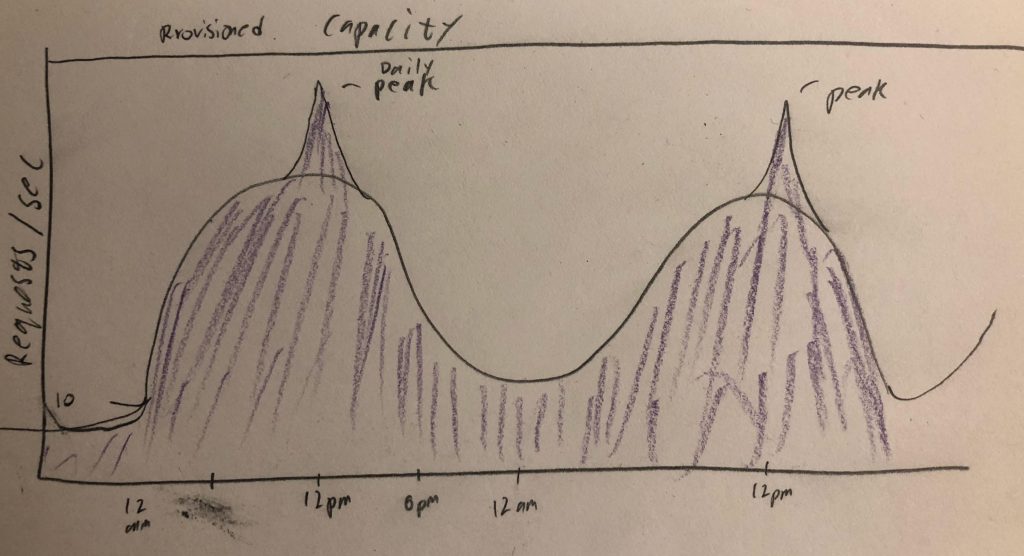
peak to trough traffic

The cloud enables us to acquire hardware on demand for our services. I have never had to rack a server or worry about hardware failure. My entire software career has been in the cloud. As an industry most of us don’t need to worry about forecasting hardware requirements months in advance. We just increase the number of virtual machines we need in the PAAS dashboard. 

This week I was investigating some unusually large peaks in our daily traffic. I was changing the bounds and timeline of the graph and noticed that we had a 10x difference peak to trough. Usage peaks for about 2 hours each day at 10x trough, about 6 hours are also peak but at 5x trough. At night our traffic drops significantly because our users are sleeping. 

My current team, like all teams I have worked with in my five year career, does not use auto-scaling. We experimented with it last year but had issues with auto-scaling interfering with our deployments in unpredictable ways. 

So we scale for our instantaneous peak of 10x our lowest traffic around 2am. Meaning we use at least 5x as much hardware as necessary. 

The drawing underestimates the impact of the instantaneous peaks which essentially double the traffic to this service. 

Auto-Scaling would be a great fit for this service. Most cloud platforms have supported this use case for years and would result in decent savings. 

If you like my writing, please buy my book on Amazon.
The Sledgeworx Guide to Getting into Software

Story development

It’s a common statement that once you are a senior engineer you don’t get to code anymore. It’s not that senior engineers are forbidden from coding, it’s still on the job description.

But senior engineers get pulled into so many tasks they rarely have time for coding. 

A senior engineers might get pulled into a critical outage, a roadmap meeting, defending architectural boundaries from other teams, assisting team members with their tasks, reviewing code, coordinating large projects with other teams. 

None of those tasks involve coding on the part of a senior engineer. And none of those tasks involve story development.

Story development is the process of taking feature requests and refining them into technical tasks.

Unless your team is stacked with experienced engineers or in a realm with little domain knowledge, story development will fall on the senior engineer.

Maintaining a ‘sprint ready’ backlog for a team of 10 engineers takes more than a 1 hour meeting once a week.

My philosophy is that, as the senior person, I should prioritize the tasks that allow the other nine people on the team to work efficiently. If the backlog is full of two sentence feature requests, the next sprint is going to be full of junior engineers figuring out the requirements. 

Don’t ignore the backlog to fight fires. Figure out what it will take to empower the non-senior part of the team to fight the fires. Then you can focus on the hire value tasks. Building the roadmap, evolving the architecture and developing stories. 

People have given up on performance in favor of Scalability

Scalability has been all the rage since the cloud made horizontal scaling easy. No longer do we have to order parts, lease colo space or rack servers. Instead there is an infinite supply of Virtual Machines out there we can rent at the press of a button. Because of this there is a tendency to start development with an architecture that will scale well horizontally. My entire career has been during the post AWS period. Pre-mature optimization is the root of all evil, but make sure to create a stateless service so we can scale it up later when its slow.

Web Servers

Its interesting to look at examples of projects that did not focus on scaling horizontally.

For example we have stackexchange’s public numbers on their performance. 

https://stackexchange.com/performance

They claim that they handle up to 450 requests/s on 9 servers. From the infographic it looks like these are 1U or 2U servers with 64GB of RAM and although its unspecified I’m guessing they have 12-24 physical cores per machine. 

These machines have around 10 times as much RAM as the VMs my team runs in production and probably over 10x the cpu performance. They handle more traffic per server with lower CPU utilization. A rough estimate from these numbers is that the stackexchange .NET service is 2.5x to 10x as performant as my Java service. That could just be the bare metal vs Virtual Machine cost since our stack has significantly less CPU. 

You might think that stackexchange is operating at an absurdly low CPU utilization at 5%, but I haven’t seen anyone operating cloud servers above 20% utilization with a sample size of 4 companies. 

Big Data

This study was done comparing single threaded performance on a modern CPU vs distributed big data algorithms. 

Single thread outperformed distributed big data computations on many (most?) problems. 

https://www.usenix.org/system/files/conference/hotos15/hotos15-paper-mcsherry.pdf

They found that optimized single threaded code outperformed distributed code in the datasets they tested. Admittedly, not all datasets will fit on a single machine. But we have to remember a single machine can now have over a TB of RAM and 100s or more TB of SSD. Single threaded performance is clocking over 5GHZ now. A single server can handle all your big data needs until your dataset exceeds dozens of Terabytes. 

I’m working on learning awk to experiment in this area. It is a relatively simple domain specific language for text processing and formatting. 

If you like my writing, please buy my book on Amazon.
The Sledgeworx Guide to Getting into Software